visual search on bing
year
2025-2026
TOOLS
Figma, Claude Code, UX Labs
team
1 designer, 1 PM, 4 engineers,
cross geo collaborators
project context
Search is no longer text-first as users increasingly combine images and text to express their intent.
Visual Search on Bing was relaunched on bing in 2018, however it remained a standalone feature, confined to the Image Detail Page. This created an opportunity to reimagine Visual Search as a native search modality embedded throughout the Bing search experience.
my role
I led the experience strategy for Visual Search — defining scalable design principles and shaping multimodal experiences that combined visual intent with traditional search. I partnered with cross-functional teams to align on solutions that could scale across Bing surfaces.
The projects below are part of multiple initiatives that helped grow Visual Search from 5M to 14M weekly active users — a 3× increase over 12 months.
key challenges
01
Hidden entry point
Visual Search lived outside the primary search experience, so users rarely discovered where to use it.
02
Text-first search by default
Search led with text input even when users' intent was clearly visual.
03
Unclear capabilities
Users had little visibility into what Visual Search could actually do, from translation and exact image matching to solving math problems.
KEY PROJECTS
01
Making Visual Search Discoverable
Projects: VS on Video; VS on IDP; VS on SERP
My Role: Competitive analysis and research, opportunity framing, growth strategy, interaction design, and stakeholder alignment.
Impact: Shipped 2 new entry points and established a hover framework now being scaled across multiple Visual Search surfaces. Contributed to growth initiatives that added 400K daily active users.
02
Bringing Visual Search to Search Results page
Projects: Visually similar answer; Pages including answer; Translate answer; mobile and Edge Right Pane; Flyout improvements
My Role: Scalable design, data-informed decisions, interaction design, cross-functional partnership, and influencing product strategy.
Impact: Shipped 4 experiences on the search results page, each with positive engagement metrics.
03
Rethinking input mechanisms
Projects: Visual Search actions on Search bar- Paste image in Search bar; Drag and drop image
My Role: Systems thinking, end-to-end flow design, rapid prototyping, and influencing product direction.
Impact: Shipped "paste image in the search bar" with positive user engagement metrics.
• PROJECT 01
Making visual search discoverable
my role: Mapping the next opportunity
As visual search matured, it wasn't obvious where to invest. I built a point of view by synthesizing competitive analysis, Google and Pinterest trend data, and emerging user behaviors — then translated the findings into opportunity areas and implementation canvases that made each direction tangible and comparable.
I audited the Bing ecosystem to identify high-impact canvases where users naturally engaged with visual search, prioritizing moments where Visual Search could deliver meaningful value and drive adoption.
I Defined an ecosystem-wide entry point strategy — mapping where and how Visual Search should surface based on user intent, content context, and each canvas' goals.
the outcome:
These directions fed into cycle planning and informed what the team prioritized including - from video to visual search; from image browsing to visual search; visual search magazine concept
Shipped Visual Search on Hover (MVP), driving a 20–25K DAU gain on a 20% flight (est. 100K at full launch
Visual Search on image detail page is being flighted AND Visual Search on Video is UNDER development
• from video to visual search •
"I saw the perfect pair of shoes in a video — but there was no way to actually find them."
Prototype tool: VS code + Claude Code
the process:
benchmarked video commerce visual search, and multimodal AI experiences- mapping interaction patterns for product and entity discovery from video. Made the process scalable by building a claude skill. This research grounded the exploration of how visual understanding could integrate into video consumption.
Defined the experience strategy by framing the core interaction questions: what Visual Search should identify, when it should appear, where it should surface, and how users should move from watching to exploring.
Established design principles that let Visual Search enhance moments of curiosity without interrupting the primary viewing experience.
Explored multiple interaction models across trigger points, placements, and navigation patterns — evaluating how each balanced discoverability, user intent, and viewing continuity.
Built high-fidelity interactive prototypes with Claude Code to simulate the end-to-end experience, enabling realistic stakeholder reviews and early engineering feasibility discussions.
Built Claude skill for compete analysis & preliminary research
• FROM IMAGE BROWSING TO VISUAL SEARCH •
"I found the perfect sofa in a photo — I just don't know how to find more like it."
Prototype tool: Figma
my role:
Conducted a survey to understand users' primary and secondary intent while browsing images as well as pain-points around visual search intents. The findings revealed users' mental models around hovering versus clicking on an image, and surfaced a key friction point: to translate text, users were resorting to a longer, workaround flow.
Established the experience strategy and design principles for surfacing Visual Search through contextual, low-friction entry points — the key being to match the level of exploration to the user's stage in the funnel.
Developed a scalable interaction framework that balanced consistency with context, letting each canvas expose Visual Search in ways that respected its primary experience.
This experience scaled to image detail page, edge hover.Partnered with Product, Engineering, and partner teams to align on priorities, weigh implementation trade-offs, and define a roadmap for rolling out the strategy across surfaces.
how the design scales:
visual search has multiple skills, based on the image, it can smartly show the relevant icon. For example solve and translate will have a different icon that stays consistent for all visual search flows.
the shimmer and entity detection feature only shows progressively when user hovers over the image to prevent feature clutter at the beginning of the funnel.

• MEANINGFUL IMAGE SEARCH ON DETAIL PAGE •
"I love these jeans on this celebrity — I just want to find a pair like them."
Prototype tool: VS code + Claude Code
the brief :
Visual Search receives the majority of its traffic from this entry point, making it one of the most critical surfaces in the experience. How can we redirect users to VS on SERP experience without disrupting the experience.
the challenge :
Visual Search receives the majority of its traffic from this entry point, making it one of the most critical surfaces in the experience. How can we redirect users to VS on SERP experience without disrupting the experience.
my role:
Partnered with the surface-owning team to synthesize user signals and behavioral metrics, uncovering the root causes behind declining user satisfaction despite high Visual Search adoption.
Reframed the design challenge — from simply increasing engagement and accommodating redirection, to redesigning the entry point around a more intuitive, predictable, user-controlled, and non-disruptive interaction model.
Defined the experience strategy and design principles by translating key usability insights — ambiguous interactions, intrusive visual treatments, and lack of user control — into clear design objectives.
Explored and prototyped multiple interaction models with Claude Code to validate end-to-end behaviors, patterns, and transitions before implementation.
Facilitated cross-functional design reviews with Product, Engineering, and partner teams — evaluating concepts through trade-off analysis across user value, feasibility, scalability, complexity, and business impact.
Drove alignment on the final proposal, balancing discoverability with usability and establishing a scalable interaction pattern for future Visual Search experiences.
INTERACTION:
• PROJECT 02
Bringing visual search results to SERP
MY ROLE: BRINGING VISUAL SEARCH TO RESULTS PAGE
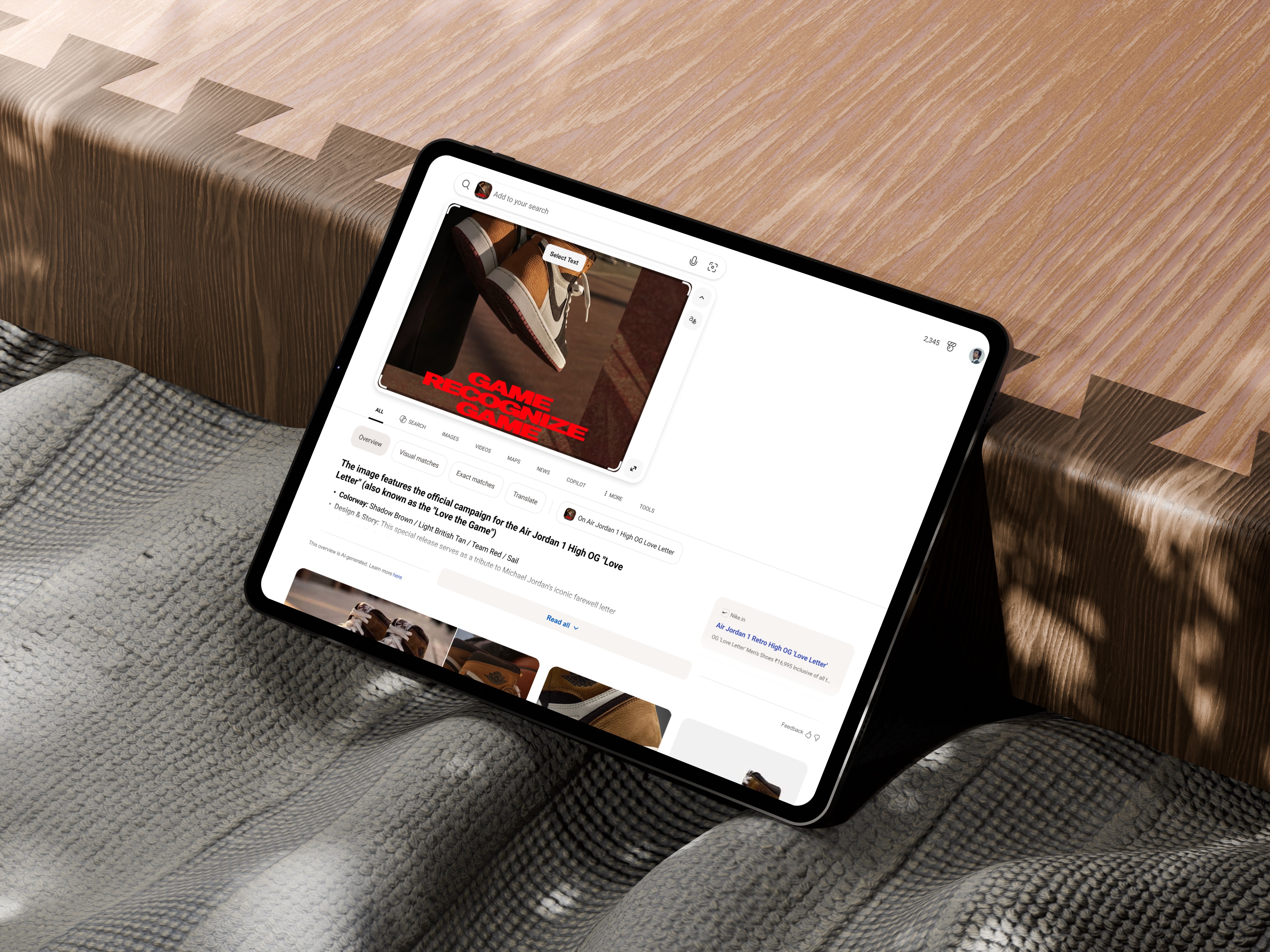
As visual search moved out of the image detail page to feature on the search results page, I partnered with the product team to define how each answer should render as a search result within our search frameworks—covering overall navigation, individual answer layout, the magazine versus mainline experience, and interaction patterns.
influenced product direction: Translation was originally built into the image upload flyout. I advocated for a dedicated translate answer as a destination for image-translation intent, rather than keeping it confined to a transient element.
solving for revenue: I also worked with the product to iterate on select answers, exploring how shopping flows could originate from visual search journeys.
Visual search answers introduced new layouts and interactions that weren't supported by the existing search design framework. I partnered with the core framework team to align on the designs and incorporate these patterns into the framework.
the prototype demos were presented to leadership while greenlighting projects
the impact:
VNext visual matches delivered imprOved RICHER EXPLORATION AND IMPROVED user interaction metrics:
the new design Surfacing 2x more visual matches directly on SERP, reducing unnecessary navigation imporving content discoverability by +3.44% overall good PCR.
+4.34% Click to image vertical usage, +4.17% DAU, +1.48% query success rate; improved content discoverabilityDESIGNED ALL MOBILE ANSWERS WHICH updated the design for EDGE RIGHT PANE EXPERIENCE FOR VISUAL SEARCH ON DESKTOP, with a substantial +28.91% lift in OVERALL PCR, this helped improve overall serp coverage by +32.13%; 13% IMPROVEMENT IN REVENUE/UU.
INTRODUCED CRAFT UPDATES TO EXISTING EXPERIENCE AND ADDED ANSWER CARD INTERACTION FORMAT TO BING LIBRARY
TRANSLATE ANSWER IS UNDER DEVELOPMENT, THE NORTHSTAR VISION OF VISUAL SEARCH ANSWER WAS ACKNOWLEDGED BY THE PRODUCT TEAM
• intent based multi-modal result •
"Wherever I am in search, I can search any image and get answers right there — no need to describe it, start over, or type out what I mean"


Prototype tool: VS code + Claude Code
• PROJECT 03
Reduce the friction of searching visually by rethinking input mechanisms
MY ROLE: designing end to end flow for image input mechanism
Bing didn't support image paste as a search input, despite clipboard being a natural way users share screenshots and images. An engineering experiment validated strong user demand but negatively impacted key quality metrics, including query reformulation and DSAT. I was tasked with defining the end-to-end image paste experience, balancing ease of use with clarity, predictability, and a cohesive multimodal search journey.
i Explored multiple experience directions for introducing clipboard-based image search, balancing discoverability, familiarity, and integration with Bing's existing search workflow.
i explored detailed design flow for paste image including Defined the end-to-end interaction model, mapping user journeys, system states, edge cases, and failure scenarios to create a robust and predictable experience that is consistent with search bar interaction patterns on SERP.
Built interactive prototypes to validate key interaction patterns and facilitate design discussions with Engineering, accelerating feasibility assessment and implementation planning.
the impact:
with the new design, the user query reformulation was addressed and the experience was shipped.
The flight showed revenue gains with 248k images pasted in first 5 days of the flight
• PASTE IMAGE IN SEARCH BAR •
"It's cumbersome to save an image to make a query, I wish I could just paste it"
Prototype tool: VS code + Claude Code
INTERACTION: