health + experts
year
2023-2025
TOOLS
Figma, user testing, ux labs
team
solo designer for projects listed below,
1 teammate, 6 pms, 20 engineers
project context
Health is one of the most searched topics online, yet finding trustworthy information remains a significant challenge. Users often have to navigate conflicting advice, varying levels of source credibility, and complex medical information before they can confidently understand or act on what they find.
my role
My work focused on reimagining the health search experience—from improving the trustworthiness, readability, and accessibility of existing experiences to envisioning zero-to-one AI-powered concepts for the future of health search. I shipped four major experiences. top span growth initiative contributed to 4× growth to 400K daily active users, revenue revamp generated $2.6M in certification revenue, and magazine answers established reusable design patterns that scaled across Bing Search.
opportunity
01
finding trustworthy health information online is difficult
Results online are cluttered with conflicting advice, content of varying quality, and sources whose credibility is difficult to assess at a glance
02
information is scattered across the web
Users struggled to find information that directly addressed their health questions, often needing to visit multiple websites to piece together a single answer
03
opportunity for a continued health journey
each query is a standalone event, with no connection to what came before or after. This leaves users to repeat context, re-navigate familiar ground, and rebuild their understanding every time
KEY PROJECTS
01
Health results on Bing
Projects: VS on Video; VS on IDP; VS on SERP
My Role: user research, information design, shaping design framework, design for trust and credibility.
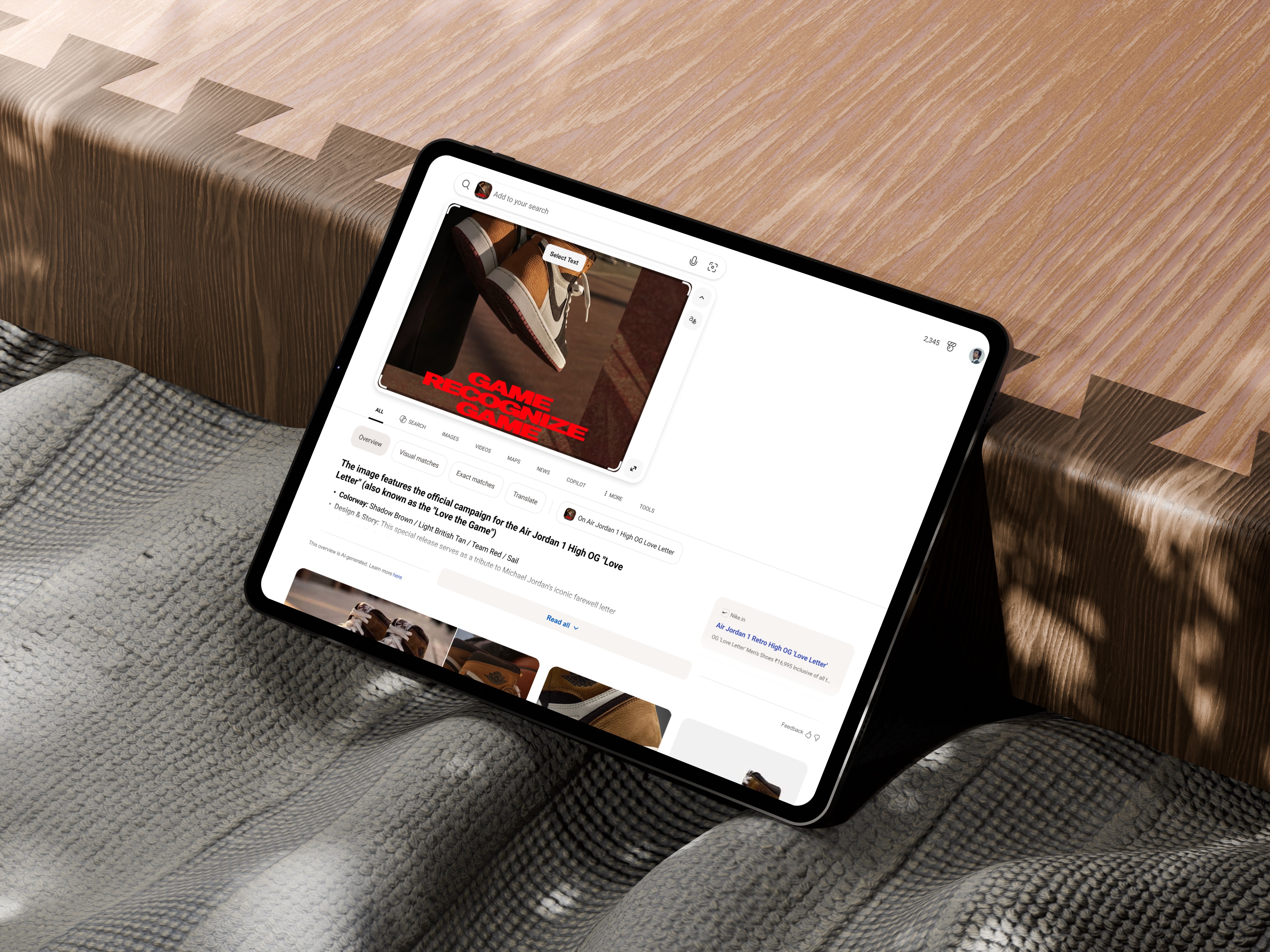
Impact: Shipped 2 new entry points and established a hover framework now being scaled across multiple Visual Search surfaces. Contributed to growth initiatives that added 400K daily active users.
02
Envisioning future of Health on Bing and Copilot
Projects: Health feed page, Northstar pitch and Copilot Concept
My Role: Envisioned detailed Bing experts feed page as a Zero-to-One concept (flighted); Envisioned concepts to pitch to senior leadership
Impact: Positive recognition from CEO of Microsoft AI
• PROJECT 01
Health results on Bing
• TRUST AND CREDIBILITY •
" I WANT TO FIND TRUSTWORTHY, EASY-TO-UNDERSTAND INFORMATION WHEN I QUERY ABOUT HEALTH ONLINE"
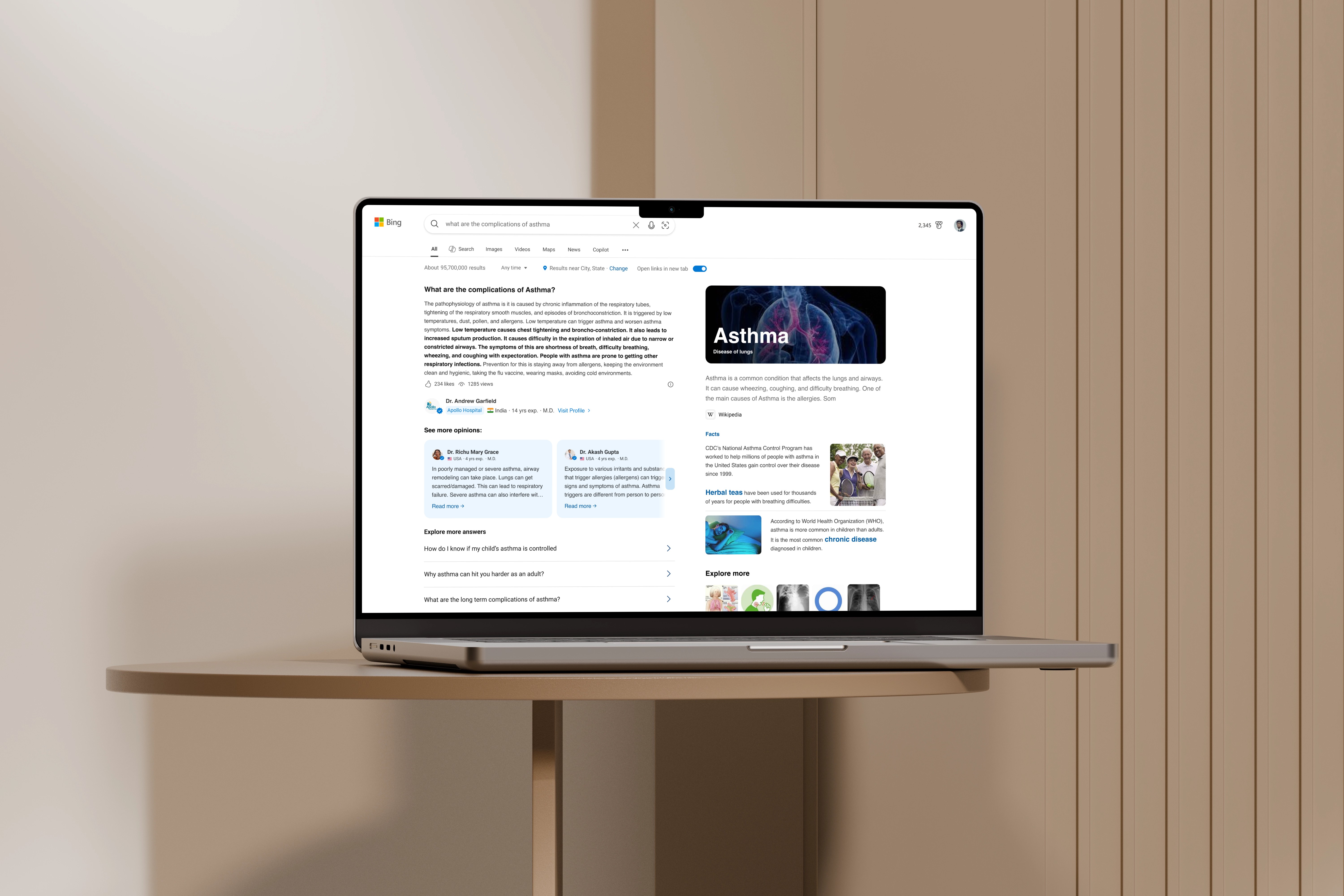
Verified health-expert answer

Brief
The existing answer for showing answers by health experts performed well, however it was getting cluttered with lot of information, not scaling to smaller size and expert credibility was not emphasized.
My role
Identified opportunities to improve answer readability by reducing visual clutter and simplifying the information hierarchy.
Partnered with the engineering team to analyze engagement metrics and uncover user behavior patterns that informed design improvements.
Restructured answer, played with type and information architecture to surface the most relevant information upfront, making long-form answers easier to scan and navigate.
Strengthened trust and credibility by redesigning attribution to better highlight expert sources and affiliated organizations.
Designed 3 answer sizes allowing content to adapt based on answer length while maintaining a consistent reading experience.
Impact and Learnings
Shipped experience with WP PCR gains (3%), Clicks per day increased by +2.54%
Positive mobile APSAT (61%),
Flight results reinforced hypothesis about showing question at the top in the small answer size.
Health-magazine

Brief
Health information on Bing was fragmented across multiple experiences, including Health Conditions, Drugs, Expert Answers, and PAA. The goal was to design a unified, dynamic health magazine that intelligently adapts to each query, presenting the most relevant information in a single, cohesive experience.
My role
Designed health content cards for a magazine-style layout, prioritizing trust, readability, and quick information scanning.
Created reusable card patterns that were incorporated into the design framework, including accessible data visualization guidelines built on existing framework components.
Validated card combinations through comparative testing against the production experience and competitor benchmarks, with winning designs selected for experimentation and flighting.
Impact and Learning
Health magazine was one of the highest performing Bing magazine answers reporting 2X engagement from standalone answer with $400K-$420K ARR in Bing revenue with SBS winrate of - 85-100%
Research answer

Brief
Conceptualize a zero-to-one experience that enables users to discover trustworthy, evidence-backed answers summarized by AI from medical research journals.
My role
Partnered with the Product Manager to conduct user research, exploring how users perceive and trust AI-generated health answers.
Collaborated with partner teams to define the user value proposition and shape the end-to-end experience for discovering evidence-backed health information.
Worked with the RAI team to develop badge copy that clearly communicates the relevance and credibility of cited medical research.
Established the information architecture and layout principles to improve the scannability, readability, and discoverability of evidence-backed content.
Presented the concept and design rationale to leadership, aligning stakeholders around the vision and product direction.
Impact and Learning
The citation badge design was adopted into the broader Bing design framework, establishing a reusable pattern for experiences where source credibility and trust are critical.
Flighting revealed that research-backed answers are a strong differentiator, but only for a subset of health queries. This reinforced the importance of identifying the right query types and user intent to ensure the experience delivers meaningful value rather than being applied universally.
China web-experts

Brief
In the China market, the Health magazine experience lagged behind the competition because it relied on a limited corpus of answers from Bing-verified health experts, while competitors surfaced expert content from across the web, enabling broader query coverage.
The opportunity was to design a Health magazine experience that incorporated trusted web expert content, expanding coverage across a wider range of health queries.
My role
Collaborated with the China team to understand local conventions for expert attribution and establish patterns that aligned with user expectations in the market.
Analyzed leading China search experiences, including Baidu, to inform the design of information hierarchy and expert badging while adapting best practices to the Bing Health experience.
Explored and prototyped multiple magazine layouts, validating designs with development tools to create a scalable solution that accommodates both single and multiple expert answers within a unified experience.
Impact and Learning
The visual design of answers in China varied from simplified experiences launched in other makets
The new experience won in SBS (PC and mobile) against top Chinese competitors
INTERACTION:
• PROJECT 02
Health experts feed page on Bing
• health as a continuous journey •
"AS SOMEONE MANAGING MY HEALTH, i WANT A TRUSTED PALCE TO DISCOVER RELIABLE HEALTH INFORMATION ON TOPICS AND QUESTIONS THAT CONCERN ME"


brief
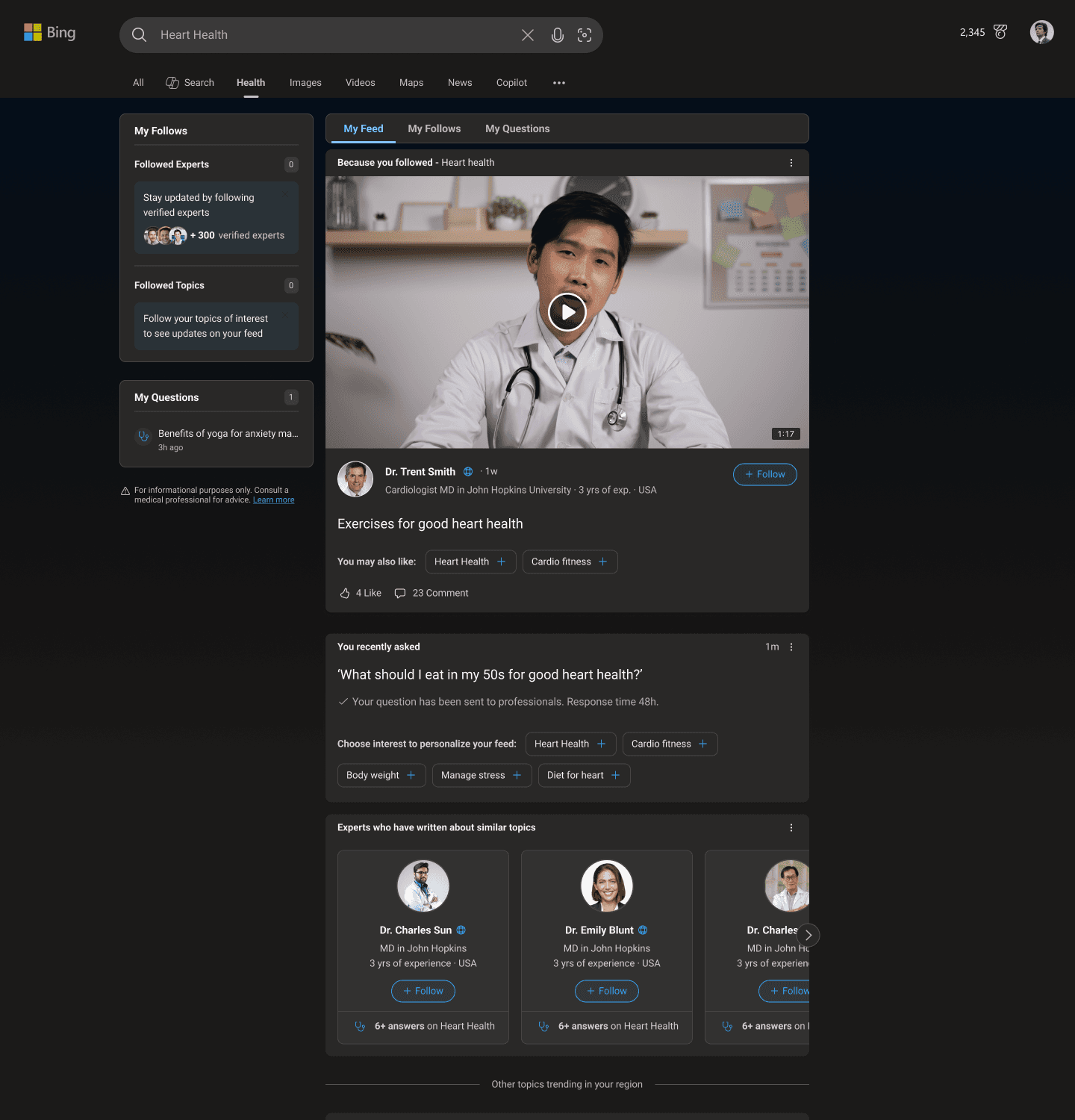
Conceptualized and designed the Health Feed as a personalized destination for discovering trustworthy health content beyond search. Rather than presenting a static stream of content, the experience adapts to users' interests, geography, recent activity, and visit patterns to surface the most relevant information at the right time.
The goal was to create a health destination for repeat usage that balances personalized discovery with credible health content
challenges
Notification gap
48hr wait time required a mechanism for users to be notified that expert has answered their question. Due to dependencies, it was a challenge to introduce this feature in MVP
Sparse feed
Expert answer coverage varied significantly by region, and answers were most relevant when localized. As a result, some users encountered sparsely populated feeds, reducing the value of the experience and discouraging repeat visits.
learnings
Gaps in end to end flow
Dependency on canvases for pinned experience made it challenging to ship this as a page as a persistent destination.
Value proposition
Relying solely on expert answers limited the Health Feed's ability to serve as a comprehensive health destination. Since users seek a broad range of health information—not just expert insights—the experience needed to evolve to include diverse content types that address different health needs and intents.
my role
User research
Conducted a survey to understand how users search for health information online and how that journey evolves over time.
Evaluated the current 'Ask an Expert' experience to identify user needs, pain points, and opportunities for improvement.
Product vision & principles
Partnered with the product team to define the page's vision, scope, and content strategy for a personalized health feed. Together, we identified the key user states the experience needed to support from first-time visits to repeat sessions and users returning after periods of inactivity.
With the scope established, I explored multiple layout directions and defined the framework that governs how content is prioritized and surfaced across these states. The framework balances user interests, geography, recent activity, and content freshness to deliver a relevant experience while avoiding repetition.
User flow & content framework
Designed the end-to-end feed experience by mapping user flows and defining how content adapts across different user states, including first-time users, repeat visitors, returning users, and multiple sessions within a day to personalized experience based on users' interests and recent activity.
To respect users' time and attention, I introduced clear completion cues that let users know when they had caught up with new content. Rather than encouraging endless scrolling, the experience provided natural stopping points while guiding users toward purposeful exploration of related health content.
Design system
Built a scalable design system with reusable components and interaction patterns to support future feature development while ensuring a consistent experience across the product.
Extended the existing Bing design system by creating health-specific component variants that preserved Bing system consistency while accommodating the unique requirements of health content and interactions.
Aligned the visual language with the broader Health brand by applying a cohesive blue-themed palette and design principles, creating a recognizable and trustworthy experience across the product.
Testing with real users
Took the MVP design to real users and tested the concept.
Users found the layout familiar and easy to navigate, they were able to identify section on the page.
Their expectation from entry point of ask an expert was to enter a chat module
These gaps were editing before flighting the updated design
• PROJECT 02
Envisioning future of health on Bing
• CONCEPT PITCH •
"AS SOMEONE LOOKING TO IMPROVE MY HEALTH, I WANT PERSONALIZED GUIDANCE TO BUILD SUSTAINABLE HEALTH HABITS."
holistic health journey focusing on building positive habits over quantitative outcomes
Envisioning a holistic health journey that covers aspect from fitness, nutrition to mental health to motivation.
The opportunity
According to WHO, 1.8 billion adults are physically inactive.
Health on MSN, features a repository of evergreen content and expert-answered questions. However, daily habit modules are isolated and lack good engagement
How might we bridge the gap between knowledge and action to foster healthy habits that enhance long-term wuality of life?
The proposal
Designed for the full health journey: Expanded the experience beyond medical expertise to support every stage of wellness—from fitness and nutrition to mental well-being and motivation.
Built for trust and personalization: Combined credible expert content with AI-powered personalization to recommend activities and content aligned with each user's goals, interests, and progress.
Designed to build lasting habits: Shifted the focus from tracking outcomes to enabling behavior change, helping users turn health knowledge into achievable daily actions through small, actionable steps.
The impact
Pitched to CEO of Microsoft AI with positive response.